“One of my rules in consulting is simple: never solve the problem I am asked to solve. Why such a counterintuitive rule? Because, invariably, the problem I am asked to solve is not the real, fundamental, root problem. It is usually a symptom.” – Don Norman
The design thinking process places the user in the center of every stage. Understanding the user and ensuring the solution works for them is the only way to create a truly effective solution.
Define is the second stage of the design thinking process. After researchers observe, interview, and analyze the users of a specific product or experience, they combine all their findings from the empathize stage. This practice includes two thought processes: analysis and synthesis.
Analysis breaks down complex concepts into smaller, more manageable problems. Synthesis is taking those pieces and creatively piecing them together to form a whole idea. (Dam, Teo, 2026).
From here, the designer can articulate the problem statement or the point of view (POV) statement. This POV statement combines the user, the need, and the insight. Creating this statement helps the process develop in a goal-oriented way focused on an actionable problem. (Dam, Teo, 2026).
The typical structure of a POV statement is: User (fill in description) needs (action) because (insight).
To see this process in action, I created POV statements for 3 apps: Goodreads, Patreon, and Oura.
For each app, I collected 3 positive reviews, 3 negative reviews, 3 suggestive reviews, and then created 2 POV statements.
Goodreads
Goodreads lets users track past and current reading and add new books to a “Want to Read” list. After reading each book, users can rate their experience and leave a public review for others to read. The algorithm provides users with a list of books they may be interested in and connects them with friends and fellow readers to see what others are up to.
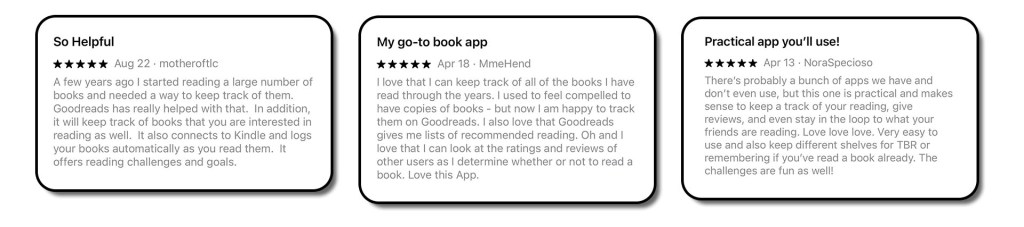
Positive reviews came from users who appreciated the ability to track their reading, connect to their Kindles, read other users’ reviews, and find the app easy to use.
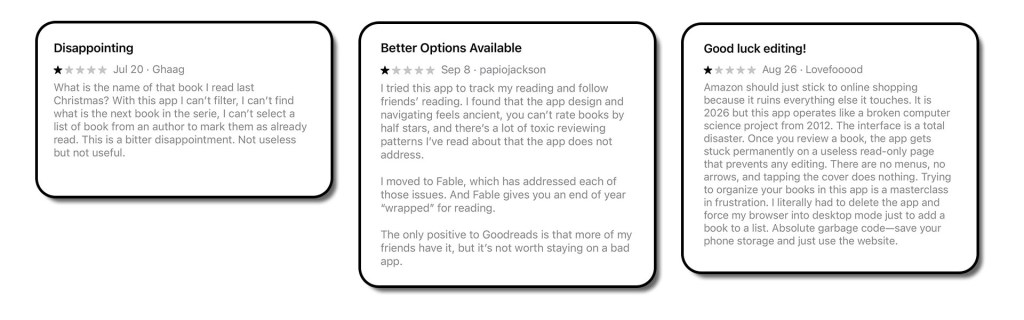
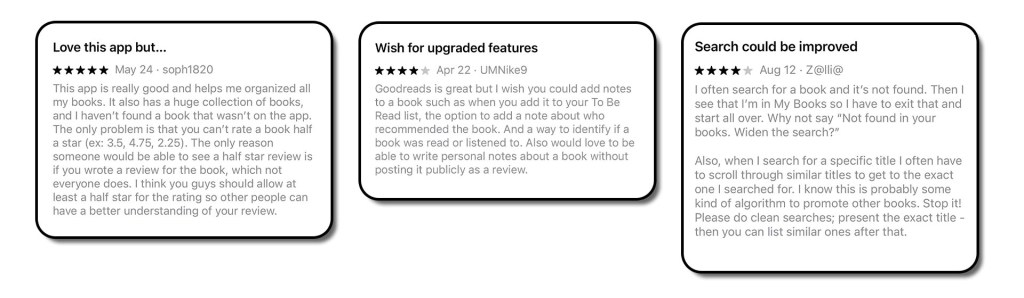
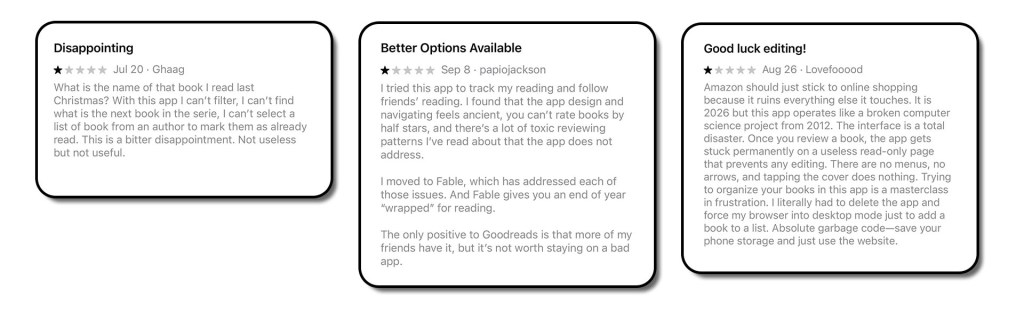
Negative reviews call out difficulty filtering results, the lack of specific ratings, and an overall UX/UI that leads to poor usability.
The suggestive reviews came from users who like using Goodreads but want specific improvements, such as a new rating system, a private notes section, and better search capabilities.
POV statements:
- Statement: Users who are avid readers need an efficient system to organize their books and notes because it will allow them to easily recall what they have read, since a large library can feel overwhelming to review.
Explanation: A large portion of Goodreads users are people who read frequently and end up growing a large collection of books. The app is meant to make organizing and referring to past reads easy. As reviews show, tracking readings strongly motivates users to use the app, but when they have trouble filtering and searching for certain books, they can get frustrated and switch to a different platform. - Statement: Users trying to get into reading need a comprehensive search engine because the number of options can be overwhelming and confusing, leading them to not choose a book to read.
Explanation: Goodreads also aims to motivate new users to pick up a book and make reading a hobby. Readers trying to find a book to start with rely on a quality search engine to guide them in the right direction. If they encounter an inconsistent, confusing search engine, as some reviews show, they will likely give up and close the app.
Patreon
Patreon is a platform where creators post content, and users can subscribe to multiple channels to comment and view their catalogs. Creators can also set up paid memberships for exclusive content and various benefits.
Positive user reviews on Patreon’s page include appreciation for the “no-frills” UI, the ability to support content creators, and the ability to personalize their experience with tier systems.

Negative reviews come from users having difficulty with the controls when viewing, navigation, and finding subscription plans.
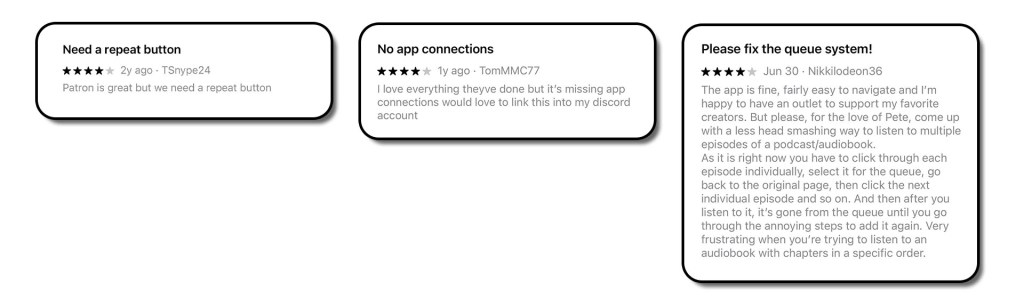
The suggestive reviews come from users requesting upgrades such as repeat buttons, cross-platform connectivity, and a more user-friendly queuing system.
POV statements:
- Statement: Users viewing content need accurate, real-time controls, such as pause/play and queuing, because a seamless viewing experience makes the platform more enjoyable to use.
Explanation: One of the main actions for users on the Patreon app is viewing content. The reviews note usability issues with controls like pause/play and queue management. These actions are expected to be accurate on any content platform. If these controls don’t match user expectations and actually hinder the viewing experience, users will look elsewhere for content. - Statement: Users searching for a specific piece of content need an efficient way to sort the media because the longer it takes to find it, the more likely they are to give up and move on.
Explanation: Before viewing, users need to find and select the specific media they want to consume. Often, the user has a specific type of content in mind. However, if the search and sorting system Patreon uses, which is also called out in the reviews, doesn’t match the user’s mental model, the user may leave the platform out of frustration.
Oura
The Oura Ring is a smart ring that tracks the user’s biometrics when worn. The data is then analyzed and communicated to the user through the Oura App. In the app, users can view sleep data, track activities, track menstrual cycles and stress levels, detect illness, and access many other features.
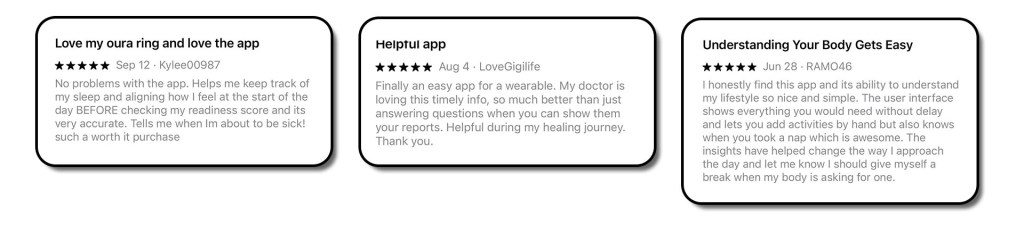
Positive user reviews describe the Oura app as easy to navigate and praise the timeliness of the data.
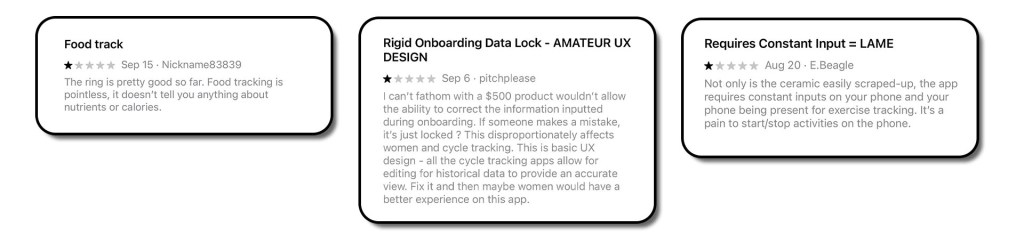
Negative reviews call out the lack of food-tracking information, the inability to edit user-entered information, and the activity-tracking feature requiring too much manual effort.
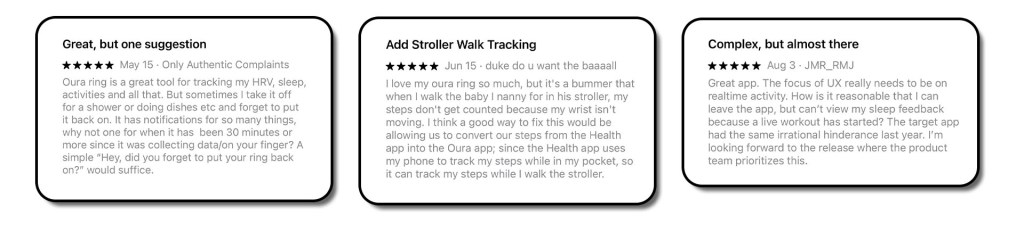
The suggestive user reviews raise new ideas like an alert if the user isn’t wearing their ring for a period of time, the ability to convert activity data from other apps, and the ability to record a live workout in the background while still using other app features.
POV statements:
- Statement: Users who use an activity tracker need adaptable software to accurately measure movement because each user has different abilities and circumstances.
Explanation: One of the main features of the Oura Ring and app is workout tracking. However, because of the tracker’s placement, workouts without hand movements may not be recorded accurately. As one review notes, a user struggles to track her walk when she pushes a stroller because her hands don’t move. She suggests adding the ability to connect to other fitness apps that track metrics such as leg movements. Fitness looks different for every person due to abilities and circumstances. An app that tracks ability should focus on making the use as inclusive as possible. - Statement: Users who rely on biometric tracking need an accessible, personalized experience because the analysis can shape the health choices they make.
Explanation: Most users consider the app’s feedback when making decisions about their daily activities and health. While Oura states the ring is not a medical device meant to monitor illnesses, users will still use it as a resource. This means the app needs to be as accurate, accessible, and personalized as possible. The user who had issues editing information is now receiving inaccurate information from Oura and is becoming frustrated.
Check out full persona pdf here:
Resources
Norman, D. (2013). The Design of Everyday Things. Basic Books. (Original work published 1988)

