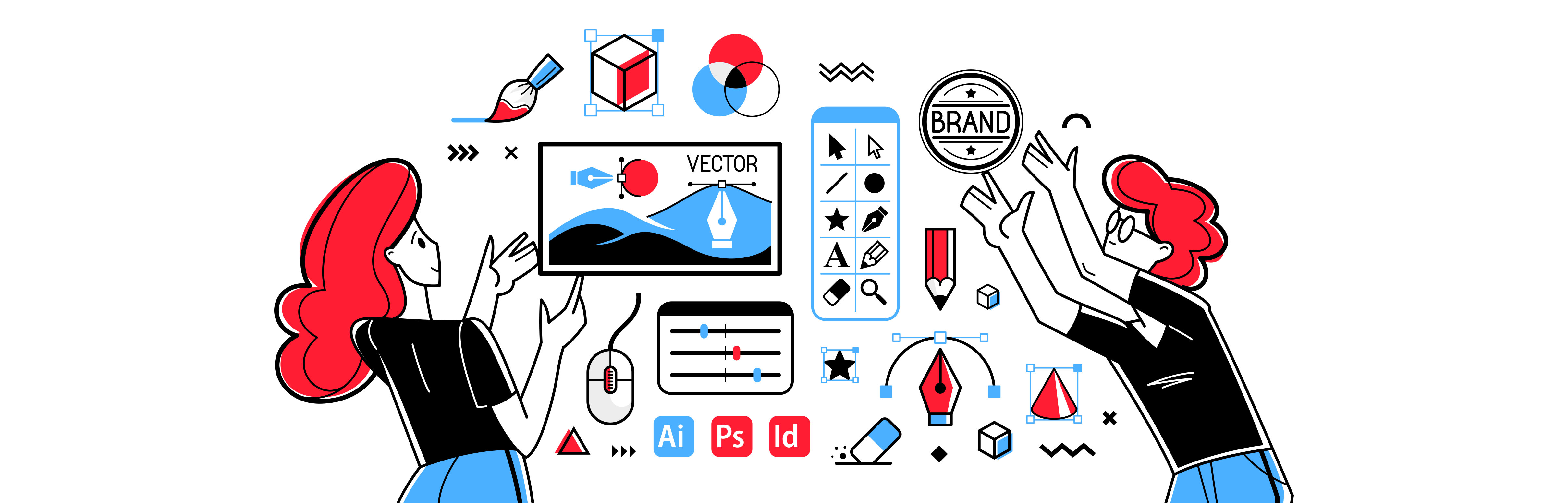
Image of two designers with a variety of icons representing a design platform.
“Content is every communication you make.” – Matthew Rayback
In Matthew Rayback’s article on what content is, he elaborates on this definition. He says he debated including “to your customers/audience,” but he argues that once content is created, it is open to anyone, not just your intended audience. The second decision when defining the term was not to phrase it as “everything you communicate,” since content is not the verb in this case; it is a noun. The content is not what you say, but it is the output of how you say it. (Rayback, 2019).
I am a graphic designer. Over the years, I have created both physical and digital content for friends and family, clients, school assignments, and myself. Each project I take on has unique goals and a purpose. As a graphic designer, I communicate messages visually and emphasize a balance of aesthetics and functionality.
Pulling Back the Curtain
Every designer’s creative process is different, and every project has specific requirements. However, I’ve adopted an overarching process that many creatives follow. The process differs when I create content for myself versus when I create content professionally for clients. For our purposes, I have outlined my current process for professional work.
- Review the brief outlining the goals, deliverables, time allotted, and any direction the client wants to take.
- Review assets and research competitors.
- Sketch multiple versions.
- Develop designs.
- Review and critique.
- Revisions.
- Release final deliverables.
This has been my standard creation process for a few years now; however, AI has changed some things. As a designer, I use AI in a specific manner. I don’t believe in putting only the project summary into an AI platform and having it design its own content. I use AI only to streamline the preparation process and support ideation. I use AI to storyboard and mock up a specific vision I have in mind before spending time developing a more finalized version. I use generative AI to quickly retouch and expand the background of various images, which once would have taken twice as long. In my process, I use AI to assist in creation, but I don’t let it be responsible for it. As a designer, I don’t want to let up on coming up with my own unique designs.
Organized Chaos
Between work, school, and personal projects, I have amassed a lot of projects. I will admit… I am a content hoarder. I have kept at least the final version of almost every project I have worked on. It is a very organized section on my hard drive separated by work, school, and personal. In those folders, each project has its own folder, with subfolders separating the assets. Think of my desktop as Russian nesting dolls of content.
For personal reasons, I think the content I have created shows my journey as a designer, and no time statute determines what stays and what gets discarded. However, my Photoshop might disagree when I get the dreaded “scratch disk full” message, but we make it work.
In my online portfolio, I actively update which projects are live to showcase the work I am most proud of and that best represents me to potential clients and employers.
More Content to Come the Dots
I am sure that as technology and the design world advance, my creative process will continue to shift. Whether it’s new AI tools or more efficient project management tactics. What will not change is my desire and goal to create content that impacts my audience. My purpose as a designer is to articulate meaning through visuals and help make the world around us more understandable.

