
When approaching a project that involves renovating or adjusting current methods to better align with your goals, you need to audit where you currently stand. Auditing means looking at content through the lens of who it is for, what your audience needs, and whether the content is clear and usable.
One of my favorite quotes from Meghan Casey defines content strategy: “Content strategy helps organizations provide the right content, to the right people, at the right times, for the right reasons” (Casey, 2015).
A successful content strategy starts with an effective content audit that helps you understand the organization and what its audience needs.
To see a content audit in practice, I analyzed the content for the non-profit organization SADD, Students Against Destructive Decisions.
SADD aims to empower students and communities to make healthy, safe decisions. It does this through a network of student-led chapters nationwide.
“Young people, empowered to help one another, are the most powerful force in prevention.” – SADD
The main focuses of this audit were:
- Organization Offerings
- Audience
- Content Types and Reviews
- Page Title Tags
- Meta Descriptions
- Header Elements
- Image Alt Tags and Accessibility
- SEO Performance
From that process, I developed a strategic content alignment summary highlighting opportunities for the organization to improve its content.
Use of AI Tools
The main focuses of this audit were:
- Screaming Frog SEO Spider: Website crawler software that audits websites and delivers data on a variety of SEO technicalities
- Semrush: An AI-powered SEO and digital marketing platform to audit websites and track competitor strategies
- WAVE web accessibility evaluation tool: Software used to evaluate web content on accessibility guidelines
- ChatGPT: A generative AI chatbot users can converse with to answer a variety of prompts
- Gemini: AI assistant powered by Google to generate results based on user inputs
Screaming Frog SEO Spider

Page title tags, meta descriptions, headers, and image alt tags are essential for optimizing website searchability and content usability.
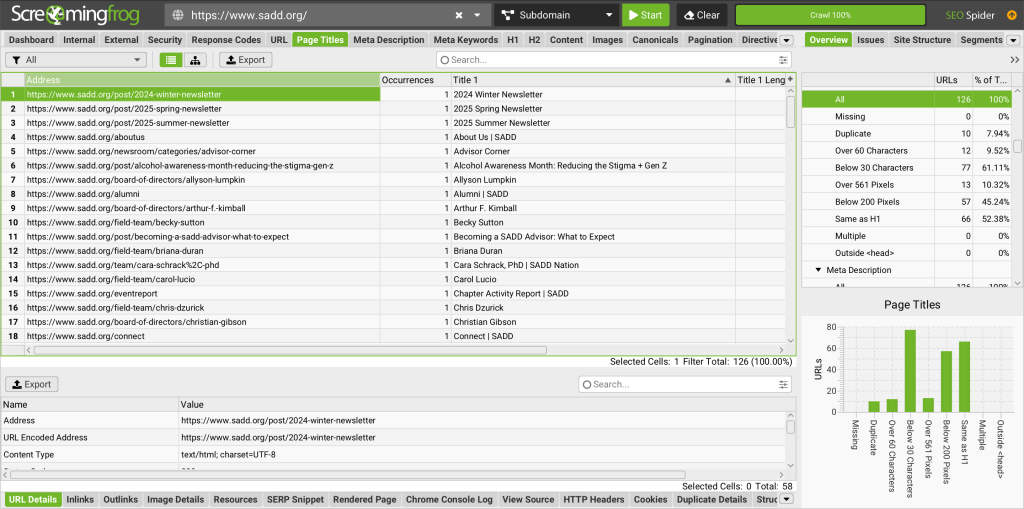
Page title tags are the titles that appear in search results. These tags should be unique and descriptive for each page, ideally matching or closely matching the H1 titles, and kept between 50 and 60 characters (Pavlik, 2026).
Meta descriptions are brief page summaries that appear in search results and persuade users to click the link. The most effective descriptions are around 105 characters, include target keywords that match a user’s search intent, and are enticing (Pavlik, 2026).
Headers are essential to the structure and scannability of any website or document, helping users and search engines understand the page. The headers are structured as follows:
- H1: title, usually the largest text size
- H2: main topics, second-largest text size
- H3: subtopics, third-largest text size
All headers should be descriptive and target the section’s keywords (Pavlik, 2026).
Image alt text briefly describes what the image is for users who can’t view it or who use assistive technology to read the page. Alt text also improves content searchability by including keywords.
Screaming Frog SEO Spider is a tool that lets users enter a URL and crawl up to 500 pages connected to that site. It then displays a dashboard where I could analyze which content had the required SEO elements, go deeper by analyzing length, and pull information built into the site’s backend that isn’t always visible to the user.
Semrush
Keywords help search engines categorize your content to be able to appear on search result pages. Place these phrases in headings and subheadings, URLs, image alt tags, and other relevant elements to increase traffic. (Pavlik, 2026).
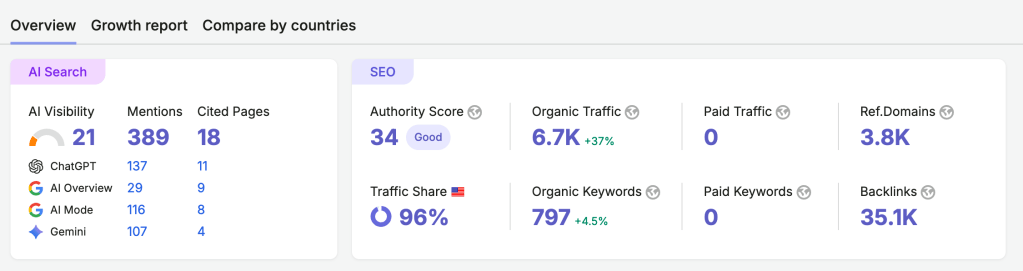
Like Spider, Semrush is a platform that audits the keywords a website uses and its current ranking on search engine results pages. Using this information, you can see what brings in the most traffic and which pages may be missed opportunities for a new audience.
WAVE web accessibility evaluation tool
Website accessibility is crucial to a successful site and an inclusive user experience. A site must work for anyone, regardless of ability, on any device, and with any software (W3C, 2026).
Page titles and headings support a website’s accessibility. Color contrast, typography, structure, and image alt text also play a major role in a site’s usability (W3C, 2023).
WAVE web accessibility tool is an AI platform that analyzes content and provides an AIM score based on the number of detectable errors, error density, and number of alerts. Using a tool like this lets you quickly quality-check content to ensure accessibility is considered in a website’s design and structure.
ChatGPT and Gemini
Screaming Frog, Semrush, and WAVE are established AI tools programmed specifically to analyze web content. ChatGPT and Gemini are AI platforms trained on large amounts of data and can answer specific user prompts, providing targeted answers rather than a broad range of information.
When analyzing and comparing results from the different AI platforms, most results were comparable, though some offered new insights. When completing an audit like this one, relying on one AI platform is not responsible on the auditor’s part. That is where ChatGPT and Gemini came into play during this audit. Using a variety of tools keeps the information more valid and can create a fuller picture to analyze.
View the full audit report here to see how these tools led me to my conclusion regarding SADD’s content:
Resources
Casey, M. (2015). Content Strategy Toolkit, The: Methods, Guidelines, and Templates for Getting Content Right (1st ed.). New Riders.
SADD. (n.d.). SADD. SADD. Retrieved November 6, 2026, from https://www.sadd.org/

