Setting the Scene
When a designer sets out to understand their user and dissect the user’s relationship with a product or service, it helps to analyze the user’s current interactions with the platform from beginning to end. To summarize and visualize these experiences, designers create a journey map.
A journey map outlines the consumer’s interactions from initial contact through each step of engagement to the long-term relationship. At each step, the map clearly details the consumer’s emotions, thoughts, and actions. Also include any pain points throughout the process, such as when a consumer gets frustrated or any situation that could be improved. (Boag, 2015).
The information incorporated in a journey map is made up of findings found in analytical research and anecdotal research:
- Analytical Research: Information on where users have come from and what they are trying to achieve. It also helps you identify points in the process where users have given up, typically gathered from platform data.
- Anecdotal Research: Stories of user experiences; you can get these by speaking to users in interviews or on social media. Important for understanding the user’s emotions.
(Boag, 2015).
Not Just a Pretty Map
In Stanford d.school’s video on journey maps, they state that you are “only as strong as your weakest link” (Stanford d.school, 2013).
A consumer’s view of a service or platform is affected by every interaction they have with the brand (Grocki, 2014). By creating a detailed breakdown of a user’s typical experience, it becomes easier to identify pain points in the process that can be improved during the design phase. Many of a user’s negative interactions may be subconscious, and the user may not be able to articulate exactly what frustrated them.
Connecting the Dots
When creating a journey map, again, the key elements to include are:
- Persona – the user
- Timeline – the experience you are documenting
- Emotions – user’s thoughts and feelings
- Touchpoints – the main interactions
- Channels – how the user interacts
To create an accurate journey map, the researcher takes the standard approach of:
- Reviewing goals
- Gathering research (analytical and anecdotal)
- Listing touchpoints and channels
- Creating an empathy map to understand the users
- Brainstorm with lenses to ideate various ideas
- Complete an affinity diagram to organize the large volume of ideas into groups
- Sketch the user journey
- Refine & digitize the user journey
- Share it with the team
Seeing the Journey Unfold
To see this process in action, I created a journey map of a user’s experience using the Goodreads app. Over the past few posts, we have broken down a potential user’s interactions with Goodreads by creating POV statements and conducting ideation sessions. In this example, I mapped the user’s journey of logging and rating a book on Goodreads.
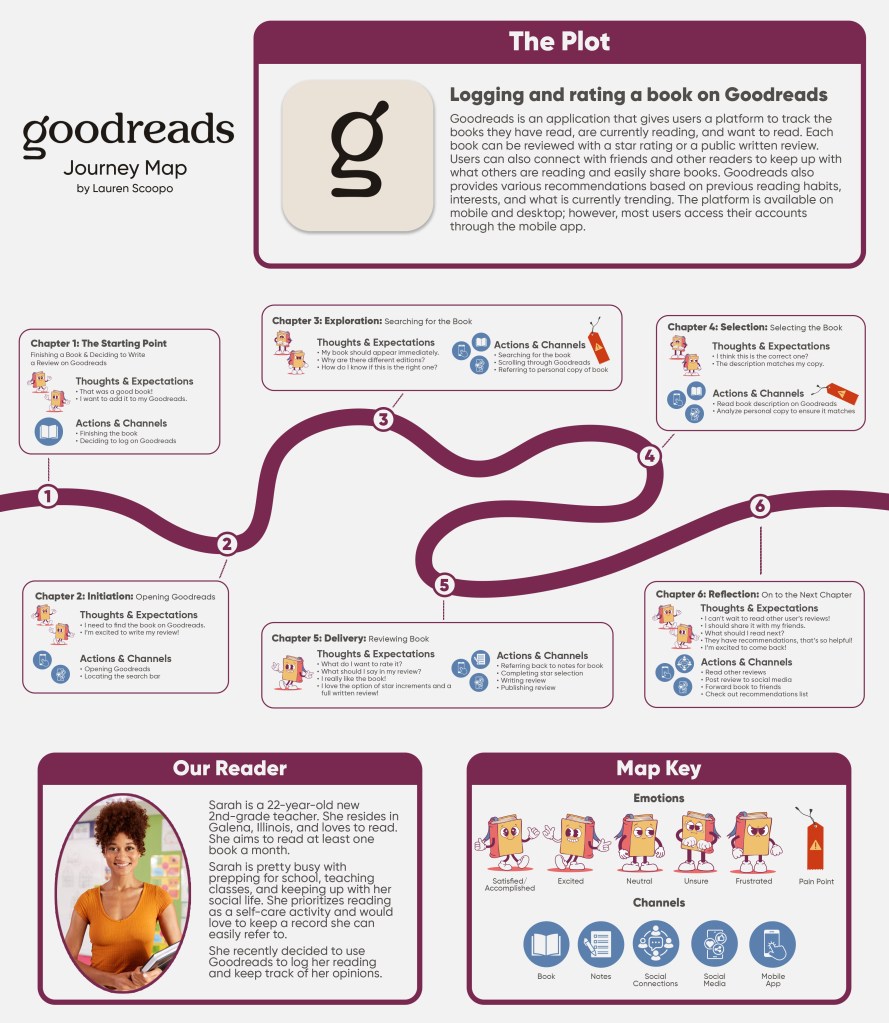
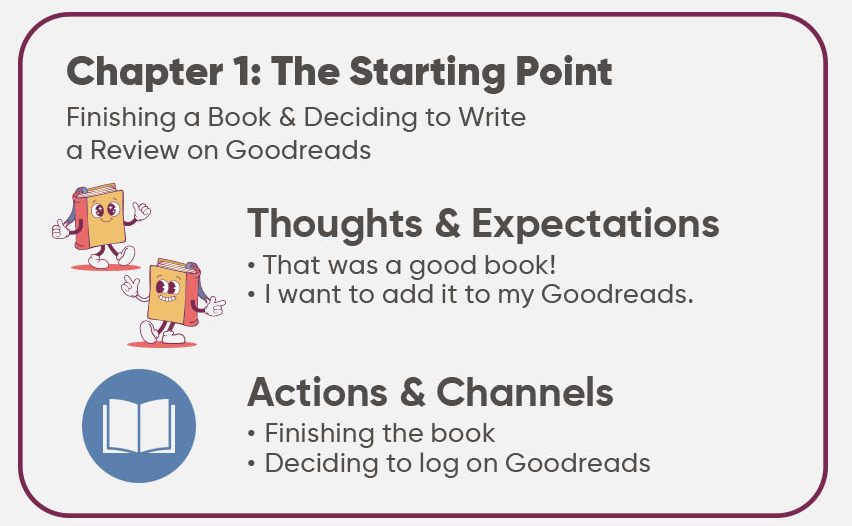
Our user, Sarah, begins with finishing a book and wanting to write a review on Goodreads. At this point, she feels satisfied and excited to complete this task.
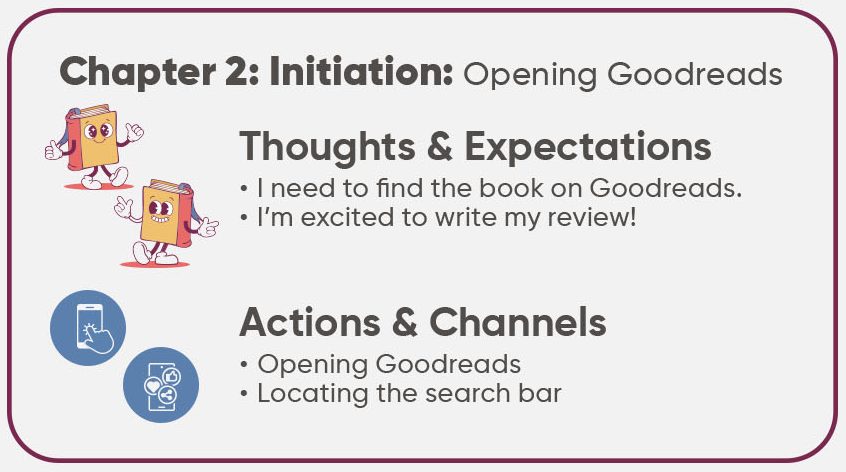
These feelings continue when she moves on to the next step of opening Goodreads.
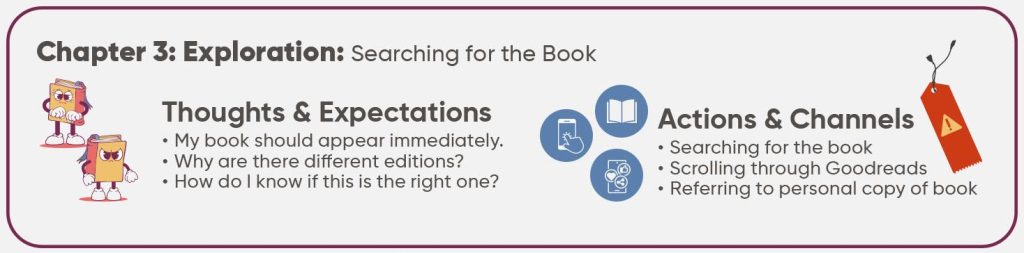
However, in touchpoint 3, she becomes frustrated and unsure as she searches for the book, since multiple results appear. The pain point icon also notes this.
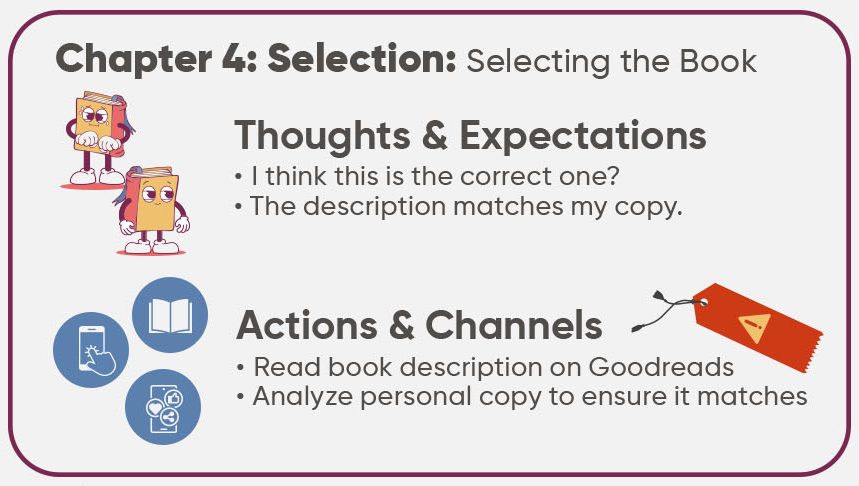
These feelings shift to neutral and unsure in touchpoint 4, when she selects the book after reading the result descriptions and believes she has chosen the correct version. This interaction is still noted as a pain point, as it is an area for improvement in the search feature.
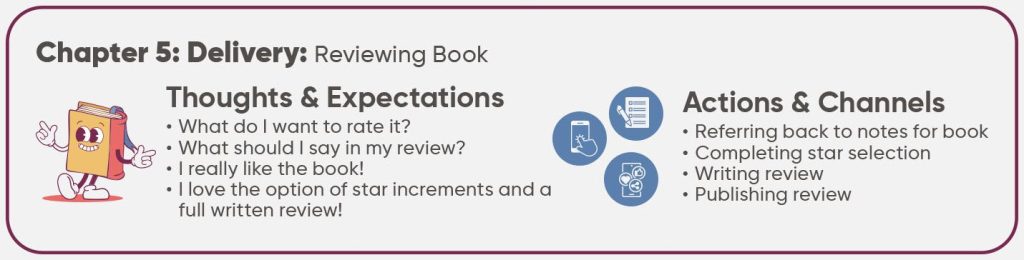
In touchpoint 5, Sarah feels excited because she is confident in her selection and moves on to crafting and publishing her review and star rating.
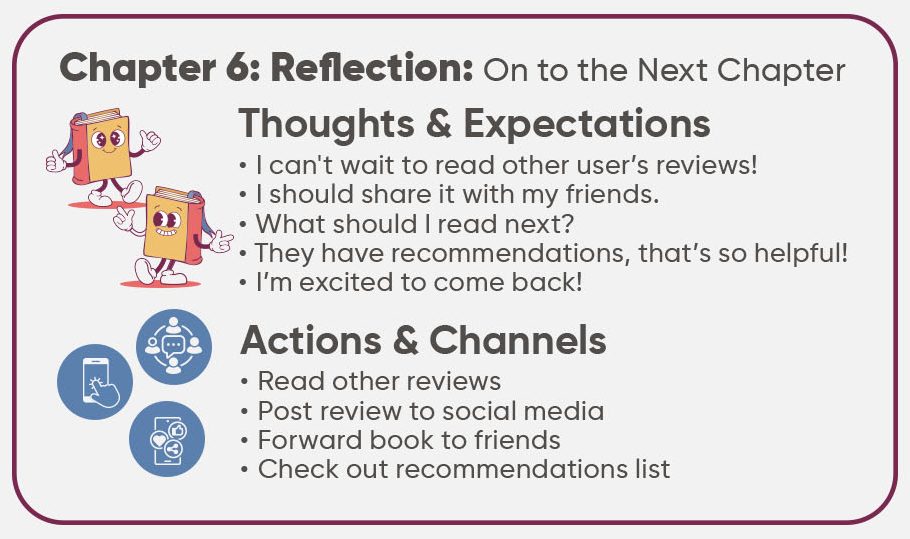
The last interaction discusses the long-term relationship between user and service. Here, we see Sarah feeling satisfied and excited as she reads other reviews and explores the recommendations Goodreads provides for her next read. This interaction leaves Sarah wanting to return to the app to review more books.
The Road Ahead
No journey maps are ever finalized. The maps must evolve as the user and platform evolve. Pain points will always emerge in any service as users’ needs change.
Journey mapping is a valuable tool that brings the user to the forefront of the user experience design process. Each step of research and each interaction with a product can yield valuable insights.
Download and Read Journey Map Here:
Resources
Stanford d.school. (2013, November 4). Journey Map. Vimeo. https://vimeo.com/7855475

